
Blog
What Is Marketplace Readiness? A Practical Guide for Brands Entering Online Retail
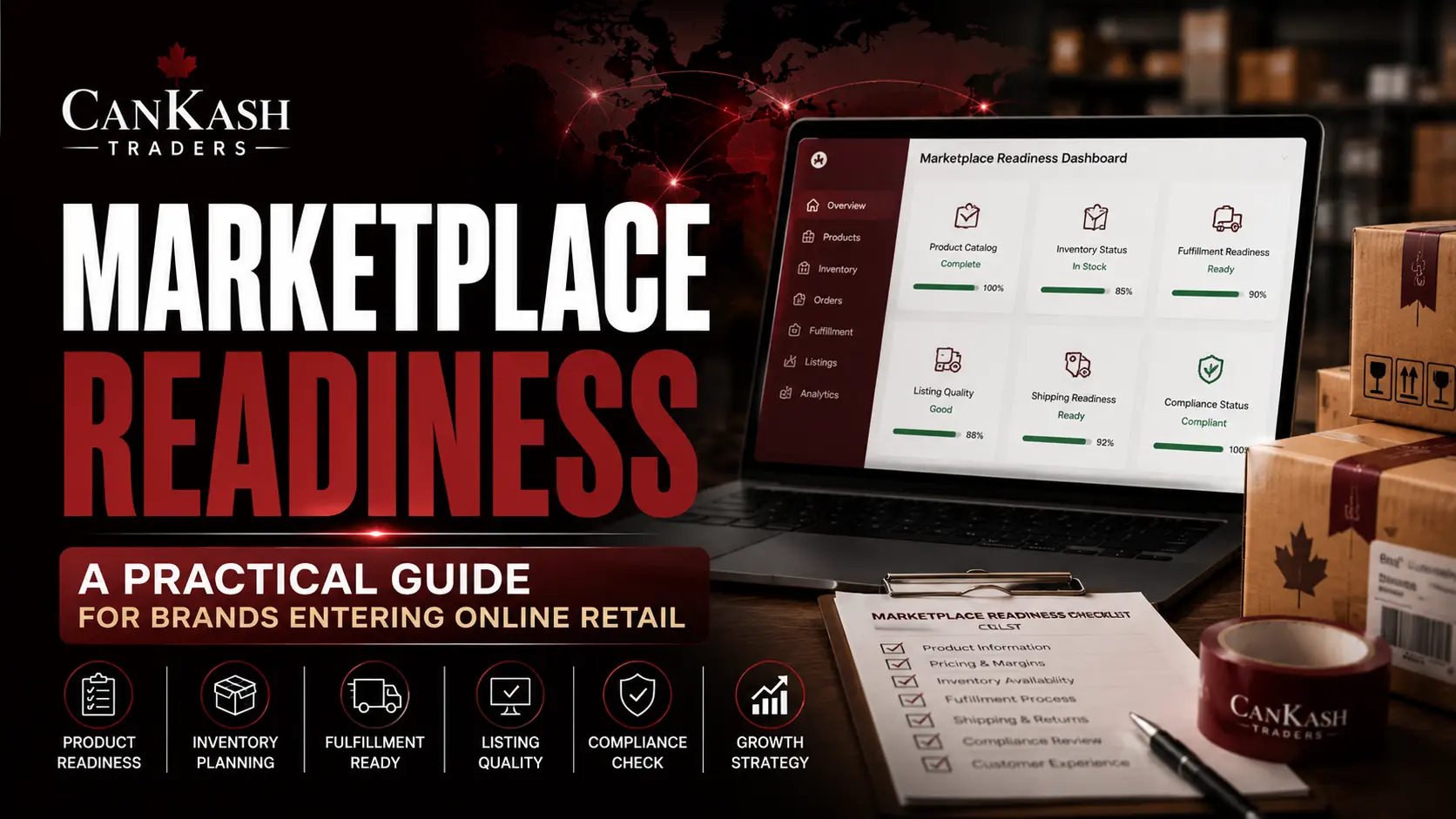
Online marketplaces look like an obvious growth move. The platforms already have the traffic, the buyer intent, and the infrastructure. For brands, suppliers, and manufacturers, the appeal is clear: list your products, reach millions of buyers, and grow.
But the brands that scale successfully across Canada–US online marketplaces are rarely the ones that moved fastest. They are the ones that moved with the most preparation.
Marketplace readiness — the degree to which a brand’s products, pricing, operations, and content are prepared for online retail — is the single most important factor in whether a marketplace expansion delivers sustainable results or creates costly problems.
This guide explains what marketplace readiness actually means, what it covers, and why investing in preparation before your first listing goes live is the decision that shapes everything that follows.
What Marketplace Readiness Means
Marketplace readiness is a brand’s operational and strategic preparedness to enter and perform on online retail platforms.
It is not simply about having a product available to sell. It encompasses the full set of conditions that determine whether a product can be listed correctly, priced sustainably, fulfilled reliably, and experienced positively by buyers across platforms like Amazon, Walmart, eBay, Newegg, and other digital retail channels.
A brand can have a strong, in-demand product and still be entirely unready for marketplace expansion if the catalog data is incomplete, the pricing structure is undefined, the inventory cannot meet demand, or the fulfillment process cannot match platform expectations.
Marketplace readiness is the foundation. Everything built on top of it — listings, traffic, reviews, revenue — depends on how solid that foundation is.
Why Marketplace Readiness Matters for Brands, Suppliers, and Manufacturers
The stakes of entering a marketplace unprepared are significant and often underestimated.
Marketplaces are competitive, high-visibility environments. Buyer decisions happen quickly. Platform algorithms reward performance and penalize operational failures. A poor early experience — bad reviews, delayed orders, listing suppressions, pricing inconsistencies — can damage a brand’s position on a platform in ways that take considerable time and effort to recover from.
For suppliers and manufacturers entering retail channels for the first time, the consequences extend further. Brand perception, retailer relationships, and long-term distribution opportunities are all shaped by how a brand performs in its early marketplace presence.
Marketplace readiness protects these investments by ensuring that when a brand enters the market, it enters with the tools, content, and operations needed to perform from day one.
Why Simply Having a Good Product Is Not Enough
A good product is necessary. It is not sufficient.
On a marketplace, every product competes on more than quality. It competes on listing visibility, content clarity, price competitiveness, fulfillment speed, and review volume — all of which are shaped by preparation, not the product itself.
A product with genuine demand potential will underperform if:
- The listing title does not reflect how buyers search for it
- The images do not meet platform standards or fail to communicate value
- The price is not competitive relative to marketplace fees and shipping costs
- The inventory cannot meet demand without creating stockouts or delays
- The brand has no process in place for managing customer inquiries or returns
The product may be excellent. The marketplace experience built around it determines whether buyers find it, trust it, and convert.
The Core Components of Marketplace Readiness
Product Catalog Readiness
Product catalog readiness means every product has the data it needs to be listed accurately and compellingly.
This includes:
- Titles that are descriptive, keyword-relevant, and aligned with how buyers search
- Descriptions that clearly communicate product value, features, and use cases
- Specifications including dimensions, materials, compatibility, and any platform-required attributes
- Images that meet platform quality standards — typically high-resolution, multiple angles, white background where required
- Variations (size, color, pack count) that are properly structured within the listing
- Product identifiers such as UPCs, EANs, or ASINs where applicable
Incomplete catalog data is one of the most common reasons products underperform or are suppressed by platform algorithms after launch.
Pricing and Margin Readiness
Marketplace pricing is more complex than setting a retail price. Brands must account for:
- Platform selling fees, which vary by category and marketplace
- Fulfillment and shipping costs, whether handled independently or through platform programs
- Return and refund costs
- Minimum margins required to sustain profitable sales
Without this clarity, brands often discover after the fact that their marketplace sales are generating revenue without generating profit. Pricing and margin readiness means these calculations are done before the first listing goes live — and a minimum advertised price (MAP) policy is in place to protect pricing integrity across channels.
Inventory and Fulfillment Readiness
Marketplaces have specific expectations around inventory availability, order processing speed, and delivery timelines. Brands that cannot reliably meet these expectations face performance penalties, account warnings, and negative buyer feedback.
Inventory and fulfillment readiness means:
- Stock levels are planned in advance and aligned with projected demand
- Packaging meets carrier and platform requirements
- Orders can be processed and shipped within platform-required timeframes
- Returns and exchanges can be handled efficiently and within policy
This area is particularly important for brands expanding into Canada–US cross-border channels, where transit timelines, customs documentation, and carrier partnerships all factor into fulfillment performance.
Category and Marketplace Fit
Not every product belongs on every platform. And within a given platform, not every category performs the same way.
Before expansion, brands should assess:
- Which platforms align with their product type and target buyer
- Which categories offer the best visibility for their specific products
- Whether platform-specific requirements — age restrictions, hazmat classifications, licensing — affect their products
- Whether their price point is competitive within the relevant category
A structured approach to category and marketplace fit prevents wasted listing effort and helps brands prioritize the channels most likely to generate meaningful results.
Brand Presentation Readiness
Retail-ready product positioning is about ensuring that every touchpoint a buyer has with a brand on a marketplace communicates quality, clarity, and consistency.
This means product images, titles, descriptions, and brand content are aligned across platforms — not repurposed casually from other channels. It means the brand voice and product story are consistent whether a buyer finds the product on Amazon, Walmart, or eBay.
Inconsistent presentation across platforms creates buyer confusion and undermines the trust that converts browsers into buyers.
Compliance and Platform Expectations
Every marketplace has its own policies — for listing content, restricted categories, product safety claims, intellectual property, and seller performance standards. Compliance failures, even unintentional ones, result in listing removals, account suspensions, and reputational setbacks.
Marketplace compliance readiness means reviewing platform-specific requirements before launch, not discovering violations after a listing is suppressed.
Customer Experience Readiness
Online marketplaces are buyer-first environments. Reviews, seller ratings, and response times are visible to every potential customer. A single wave of negative reviews from a poorly managed launch can affect product visibility for months.
Customer experience readiness means:
- A process is in place for responding to buyer inquiries promptly
- Returns are handled efficiently and in line with platform policy
- Order accuracy is prioritized to minimize post-sale issues
- The brand is monitoring its listings and performance metrics actively
What Happens When Brands Rush Into Marketplaces Without Readiness
The pattern is common: a brand enters a marketplace with momentum and good intentions, but without the preparation to perform. Early listings go live with incomplete data. Pricing is not calibrated to account for fees. Inventory runs out during an initial demand spike. Fulfillment delays generate negative feedback. Ratings drop.
Recovering from a weak marketplace launch is significantly harder than preparing properly before one. Platform algorithms penalize poor early performance in ways that take sustained effort to reverse. And buyer-facing damage — low ratings, unaddressed reviews, inconsistent brand presentation — is visible to every future customer.
The cost of readiness is modest. The cost of unreadiness is not.
Example: A Brand With a Strong Product but Weak Marketplace Readiness
Consider a manufacturer with a well-designed, competitively priced product. Early demand signals are positive. The decision is made to expand into online marketplaces quickly to capture the opportunity.
The listings go live — but the product images are repurposed from a trade show presentation and do not meet platform quality standards. The title is the internal SKU name rather than a buyer-facing description. Pricing does not account for marketplace fees, resulting in thin margins. Inventory was not pre-positioned for the volume generated by an initial promotion.
Within weeks: listings are suppressed due to image quality issues. Buyers who do find the product leave questions that go unanswered. A small number of delayed orders generate reviews that drag the seller rating below competitive levels.
The product itself never changed. The readiness gap is what shaped the outcome.
Marketplace Readiness Checklist for Brands
Use this checklist to evaluate your brand’s readiness before entering Canada–US online marketplaces:
- Clear product catalog — All products are fully documented with accurate data
- Professional product images — Images meet platform quality and dimension standards
- Accurate product specifications — Dimensions, weight, materials, and attributes are complete
- Strong product descriptions — Descriptions are clear, buyer-focused, and platform-optimized
- Defined pricing and margins — Retail price, fees, shipping, and margins are calculated
- Inventory availability — Adequate stock is available to meet demand without stockouts
- Packaging and shipping readiness — Packaging meets carrier and platform requirements
- Return and support process — A clear process exists for returns, refunds, and buyer inquiries
- Category fit assessment — Products are matched to the right platforms and categories
- Marketplace compliance review — Platform policies have been reviewed for each target marketplace
- Canada–US expansion considerations — Cross-border shipping, customs, and carrier requirements are understood
- Long-term brand growth goals — There is clarity on which channels to prioritize and how the brand’s marketplace presence will be managed over time
How CanKash Traders Helps Brands Become Marketplace Ready
CanKash Traders is a Canada-based eCommerce marketplace distribution company focused on helping brands, suppliers, and manufacturers expand across Canada–US online retail channels with structure and preparation.
The approach begins before any listing goes live. Understanding a brand’s product catalog, pricing parameters, fulfillment capabilities, and distribution goals is the foundation of the work — because marketplace support without readiness is just activity, not strategy.
CanKash Traders brings a distribution-partner perspective to marketplace readiness: thinking about product positioning, channel fit, pricing integrity, and long-term brand growth as interconnected elements rather than separate tasks.
For brands that want to enter Canada–US marketplaces — including Amazon, Walmart, eBay, Newegg, and other digital retail channels — with confidence and a plan, CanKash Traders offers a structured starting point.
Learn more about working with CanKash Traders → About Us | Our Services | Partner With Us | Contact Us
Conclusion
Marketplace readiness is not a formality. It is the foundation on which every successful online retail expansion is built.
Brands that prepare — that invest in product catalog quality, pricing clarity, fulfillment infrastructure, and brand presentation — enter marketplaces with the conditions needed to perform. Brands that skip that preparation enter with products that may never reach their potential, on platforms that reward consistency and penalize gaps.
The opportunity across Canada–US online marketplaces is real. Capturing it fully requires more than a listing. It requires readiness.
Connect With CanKash Traders
If your brand is preparing to enter Canada–US online marketplaces, connect with CanKash Traders to explore a structured marketplace growth conversation.
Frequently Asked Questions
What is marketplace readiness? Marketplace readiness refers to the degree to which a brand’s products, pricing, operations, and content are prepared for entry into online retail platforms. It covers everything from product listing quality and inventory planning to fulfillment infrastructure, platform compliance, and customer experience — the full set of conditions that determine whether a marketplace expansion succeeds or struggles.
Why is marketplace readiness important before selling online? Entering a marketplace without readiness creates predictable problems: suppressed listings, pricing that does not account for fees, fulfillment delays, negative reviews, and brand presentation that does not convert browsers into buyers. These issues are significantly harder to correct after launch than they are to prevent through preparation. Marketplace readiness ensures brands enter online retail with the right foundations in place.
What should brands prepare before entering Amazon or Walmart Marketplace? Before listing on any major marketplace, brands should have a fully documented product catalog with platform-quality images and descriptions, a clear pricing and margin structure that accounts for selling fees and shipping, an inventory and fulfillment plan that meets platform delivery standards, and a review of category fit and compliance requirements for each specific platform. A structured pre-launch readiness review reduces the risk of avoidable listing and operational issues.
How does fulfillment readiness affect marketplace growth? Fulfillment is one of the most operationally visible elements of the marketplace experience — for both buyers and platform algorithms. Delayed orders, stockouts, and packaging failures generate negative reviews and seller performance penalties that affect listing visibility and buyer trust. Fulfillment readiness ensures that when demand arrives, the infrastructure to meet it is already in place.
How can CanKash Traders help with marketplace readiness? CanKash Traders works with brands, suppliers, and manufacturers to support structured marketplace expansion across Canada–US online retail channels including Amazon, Walmart, eBay, and Newegg. The focus is on helping brands prepare before they scale — with attention to product positioning, channel fit, pricing structure, and distribution strategy. Brands interested in exploring marketplace readiness support are invited to connect with the CanKash Traders team.
Related Posts
Why Brands Need a Marketplace Distribution Partner Before Scaling Online
Selling Online Marketplace Distribution Strategy Product is listed without a broader channel plan Products enter channels with structure and purpose

 Canada